War Is A Racket by Major General Smedley Butler
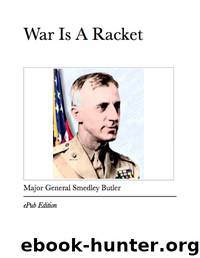
Author:Major General Smedley Butler
Language: eng
Format: epub
Tags: History
Published: 2012-02-07T05:00:00+00:00
There are thousands and thousands of these cases, and more and more are coming in all the time. The tremendous excitement of the war, the sudden cutting off of that excitement -- the young boys couldn’t stand it.
That’s a part of the bill. So much for the dead -- they have paid their part of the war profits. So much for the mentally and physically wounded -- they are paying now their share of the war profits. But the others paid, too -- they paid with heartbreaks when they tore themselves away from their firesides and their families to don the uniform of Uncle Sam -- on which a profit had been made. They paid another part in the training camps where they were regimented and drilled while others took their jobs and their places in the lives of their communities. The paid for it in the trenches where they shot and were shot; where they were hungry for days at a time; where they slept in the mud and the cold and in the rain -- with the moans and shrieks of the dying for a horrible lullaby.
But don’t forget -- the soldier paid part of the dollars and cents bill too.
Up to and including the Spanish-American War, we had a prize system, and soldiers and sailors fought for money. During the Civil War they were paid bonuses, in many instances, before they went into service. The government, or states, paid as high as $1,200 for an enlistment. In the Spanish-American War they gave prize money. When we captured any vessels, the soldiers all got their share -- at least, they were supposed to. Then it was found that we could reduce the cost of wars by taking all the prize money and keeping it, but conscripting [drafting] the soldier anyway. Then soldiers couldn’t bargain for their labor, Everyone else could bargain, but the soldier couldn’t.
Napoleon once said, "All men are enamored of decorations . . . they positively hunger for them."
So by developing the Napoleonic system -- the medal business -- the government learned it could get soldiers for less money, because the boys liked to be decorated. Until the Civil War there were no medals. Then the Congressional Medal of Honor was handed out. It made enlistments easier. After the Civil War no new medals were issued until the Spanish-American War.
In the World War, we used propaganda to make the boys accept conscription. They were made to feel ashamed if they didn’t join the army.
So vicious was this war propaganda that even God was brought into it. With few exceptions our clergymen joined in the clamor to kill, kill, kill. To kill the Germans. God is on our side . . . it is His will that the Germans be killed.
And in Germany, the good pastors called upon the Germans to kill the allies . . . to please the same God. That was a part of the general propaganda, built up to make people war conscious and murder conscious.
Download
This site does not store any files on its server. We only index and link to content provided by other sites. Please contact the content providers to delete copyright contents if any and email us, we'll remove relevant links or contents immediately.
| Anthropology | Archaeology |
| Philosophy | Politics & Government |
| Social Sciences | Sociology |
| Women's Studies |
Nudge - Improving Decisions about Health, Wealth, and Happiness by Thaler Sunstein(7689)
The Fire Next Time by James Baldwin(5428)
iGen by Jean M. Twenge(5407)
Adulting by Kelly Williams Brown(4564)
The Sports Rules Book by Human Kinetics(4377)
The Hacking of the American Mind by Robert H. Lustig(4369)
The Ethical Slut by Janet W. Hardy(4241)
Captivate by Vanessa Van Edwards(3837)
Mummy Knew by Lisa James(3686)
In a Sunburned Country by Bill Bryson(3533)
The Worm at the Core by Sheldon Solomon(3483)
Ants Among Elephants by Sujatha Gidla(3459)
The 48 laws of power by Robert Greene & Joost Elffers(3230)
Suicide: A Study in Sociology by Emile Durkheim(3017)
The Slow Fix: Solve Problems, Work Smarter, and Live Better In a World Addicted to Speed by Carl Honore(3001)
The Tipping Point by Malcolm Gladwell(2909)
Humans of New York by Brandon Stanton(2864)
Handbook of Forensic Sociology and Psychology by Stephen J. Morewitz & Mark L. Goldstein(2692)
The Happy Hooker by Xaviera Hollander(2683)
